How AI is dissolving the equation that has governed service businesses for decades — and why the tools we use to manage them are falling dangerously behind.
Every professional service business in the world runs on the same invisible formula: Output = Hours × People. Agencies sell hours. Consultancies bill time. IT service providers track effort. The entire multi-billion-dollar PSA (Professional Service Automation) industry — from Harvest to MOCO to mite — exists to measure, optimize, and invoice around this equation.
That equation is breaking apart.
A five-person creative agency today can produce what used to require twenty people. A solo DevOps engineer with the right AI setup can manage infrastructure that once demanded a team. A copywriter can generate, test, and refine messaging at a pace that would have been inconceivable three years ago. The bottleneck is no longer human capacity. It’s shifting to judgment, expertise, client relationships, and creative direction.
This isn’t a future scenario. It’s happening right now, in thousands of service firms across every industry. And it raises a question that almost nobody is answering well: If the fundamental unit of value is no longer the hour, what replaces it?
Humans vs. AI: An Honest Comparison
Before we can rethink how service businesses operate, we need to be honest about what AI actually does well and where it falls short. The discourse tends to oscillate between utopian hype and dismissive skepticism. The reality is more nuanced — and more interesting.
Where AI Excels
AI agents are genuinely superior to humans in several dimensions that matter enormously in professional services.
Speed and throughput. An AI content agent can draft twelve tagline variations in the time it takes a human copywriter to finish one. An infrastructure-as-code agent can generate Terraform configurations in seconds. A code review agent can scan an entire codebase overnight. This isn’t marginal improvement — it’s a different order of magnitude.
Consistency and tirelessness. AI doesn’t have bad days. It doesn’t get tired at 4pm on a Friday. It applies the same quality standard to the 500th asset export as it does to the first. For repetitive, high-volume tasks — resizing images across formats, generating unit tests, monitoring Kubernetes clusters, checking SEO compliance — this reliability is transformative.
Breadth of knowledge. A single AI agent can draw on knowledge across design patterns, programming languages, regulatory frameworks, and industry best practices simultaneously. No human, however talented, carries that breadth.
Cost structure. The marginal cost of AI work approaches zero relative to human labor. An API call that generates a logo concept costs cents. A human designer working on the same task costs tens or hundreds of euros per hour. As AI capabilities improve, this gap only widens.
Where Humans Remain Irreplaceable
But the picture isn’t one-sided. Humans possess capabilities that AI simply cannot replicate — and these capabilities are precisely what clients actually pay for.
Judgment and taste. AI can generate a hundred logo concepts. A human art director knows which three are worth showing to the client and why. This curatorial judgment — the ability to recognize quality, appropriateness, and emotional resonance — remains deeply human. It’s the difference between generating options and making decisions.
Empathy and relationships. Clients don’t buy deliverables. They buy trust, understanding, and the feeling that someone genuinely cares about their business. No AI agent can read the room in a workshop, sense that a CEO is nervous about a rebrand, or build the kind of relationship that sustains a multi-year retainer. The human ability to connect, persuade, and navigate social complexity is not a soft skill — it’s the hardest skill there is.
Strategic thinking and contextual understanding. AI operates on patterns. Humans operate on meaning. A strategist who understands that a client’s market is shifting, that their competitor just pivoted, that their internal culture won’t support a certain direction — that contextual intelligence is something AI can inform but not replace.
Accountability and ownership. When something goes wrong — and in service businesses, things always go wrong — someone needs to own it. Someone needs to look the client in the eye, explain what happened, and make it right. That requires a human being with the authority and the willingness to take responsibility.
Creative leaps. AI excels at interpolation — generating variations within known patterns. Humans excel at extrapolation — making unexpected connections, challenging assumptions, and producing genuinely novel ideas. The most valuable creative work in any agency isn’t iterative refinement. It’s the moment someone says, “What if we approached this completely differently?”
The Honest Truth
Neither humans nor AI are universally better. They’re differently capable. The organizations that will thrive are the ones that stop asking “Will AI replace us?” and start asking “How do we build teams where each contributor — human or AI — operates in the zone where they’re strongest?”
The Case for Hybrid Teams
The answer isn’t AI or humans. It’s AI and humans, working as a single integrated team.
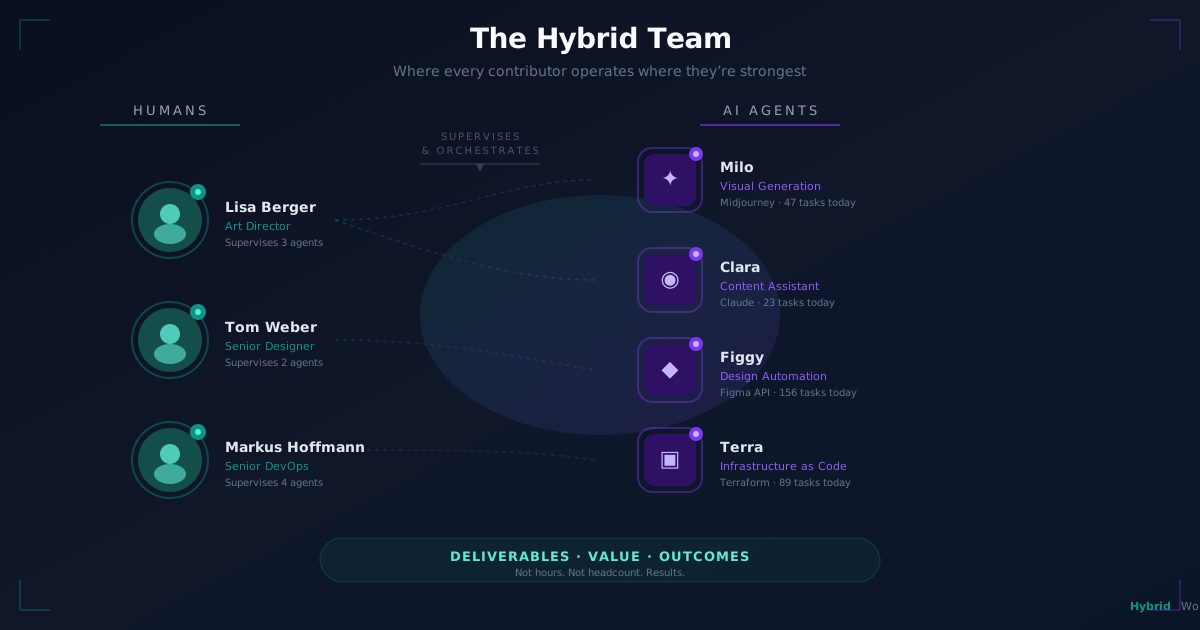
Consider how this looks in practice. In a creative agency working on a corporate identity project, the team might consist of three humans — an art director, a senior designer, and a copywriter — alongside six AI agents, each with a distinct role. A visual generation specialist named “Milo” produces concept variations. A content assistant called “Clara” drafts and refines copy. A design automation agent handles asset exports and format conversions. A motion agent creates logo animations. An SEO specialist optimizes content. An asset research agent curates reference imagery.
Each human supervises specific agents. The art director steers the visual agents. The copywriter guides the content agents. The workflow looks less like “people using tools” and more like “a team collaborating” — because that’s exactly what it is.
In an IT services context, the pattern is the same. A senior DevOps engineer works alongside an infrastructure-as-code agent, a Kubernetes monitoring agent, a security analysis agent, a documentation agent, and a code review agent. The human makes architectural decisions, handles client communication, and manages escalations. The agents handle the volume, the monitoring, and the routine.
This isn’t a thought experiment. It’s already happening in forward-thinking agencies and service firms. The problem is that none of the tools these businesses rely on can actually manage it.
The PSA Problem: Software Built for a World That No Longer Exists
Here’s where the disconnect becomes painfully obvious.
Every PSA tool on the market today — Harvest, MOCO, mite, Toggl, Productive, Scoro, and dozens of others — is architected around one core concept: human time tracking. The entire data model, the user interface, the billing logic, the reporting engine — all of it assumes that work is performed by humans, measured in hours, and billed at hourly rates.
These tools are excellent at what they do. MOCO is beautifully designed for German-speaking agencies. Harvest is a reliable workhorse for freelancers and small teams. mite is elegant in its simplicity. But they all share the same blind spot: they cannot model a team that includes non-human contributors.
When these platforms add “AI features,” they do exactly what you’d expect: they use AI to make time tracking easier. Auto-fill timesheets. Generate reports. Suggest project estimates. This is optimizing a model that is becoming obsolete. It’s like adding a better carburetor to a car that needs an electric motor.
The fundamental problems are structural.
No concept of AI team members. In current PSA systems, a “resource” is always a human with a name, an hourly rate, and a weekly capacity. There’s no way to represent an AI agent as a team member with its own role, cost structure, and output metrics. AI costs — API calls, token consumption, compute charges — have no natural home in these systems.
Time as the only unit of measurement. When a designer spends two hours orchestrating AI tools to produce what used to take twenty hours, the PSA system sees “2 hours of design work.” It has no way to capture the actual value created or the AI contribution that made it possible. The productivity paradox is invisible to the software.
Billing logic that doesn’t match reality. If your team is 5x more productive thanks to AI, your hourly billing model breaks. You either bill fewer hours (and your revenue drops) or you inflate your hourly rate to absurd levels (and your clients revolt). The tools don’t support deliverable-based pricing, value-based billing, or any model that isn’t fundamentally anchored to hours.
No AI cost accounting. Running AI agents costs real money. Claude API calls, Midjourney subscriptions, cloud compute for custom models, embeddings for RAG systems — these are actual line items on a P&L. Current PSA tools have no mechanism to track these costs, attribute them to projects, or factor them into margin calculations. They’re invisible.
No contribution tracking across human and AI work. When a deliverable is produced through a combination of human creativity and AI generation, there’s no way to understand the mix, optimize it, or communicate it to clients. The entire hybrid workflow is a black box to the software.
Rethinking PSA from First Principles
If we were building a Professional Service Automation platform today — with no legacy assumptions — what would it look like?
The answer starts with a fundamental shift in the core concept. Instead of tracking time, we should be tracking value creation. Instead of managing headcount, we should be managing teams that include both humans and AI agents. Instead of billing hours, we should be billing deliverables.
Three Pillars of a Next-Gen PSA
Pillar 1: Contribution Tracking
The system should automatically detect and attribute contributions across all team members — human and AI. It connects to the tools teams actually use (Figma, GitHub, Jira, Slack, Microsoft 365, AI APIs) and understands what was created, by whom (or by which agent), for which client, and at what quality level.
For humans, this means less manual time tracking and more automatic recognition of actual work. For AI agents, it means tracking tasks completed, tokens consumed, compute used, and outputs generated. For the organization, it means finally understanding the true human/AI mix behind every deliverable.
Pillar 2: Deliverable-Based Pricing
Instead of selling hours, agencies sell outcomes. The system maintains a catalog of deliverables with reference prices, modified by complexity, urgency, and quality requirements. A logo design has a price. A Kubernetes migration has a price. A content strategy has a price.
Internally, the system calculates the actual cost of producing each deliverable — human labor costs plus AI costs — and shows the margin in real time. As AI becomes more capable and costs decrease, margins improve automatically. The agency benefits from efficiency without having to justify lower hour counts to clients.
Clients see what they’re paying for: deliverables with clear descriptions, progress tracking, and fixed prices. Optionally, agencies can activate a “transparency mode” that shows clients the human/AI mix behind their work — positioning themselves as modern, efficient, and honest rather than hiding their AI usage.
Pillar 3: AI Cost Accounting
Every AI interaction is tracked as a real cost: token consumption per provider, compute charges for image and video generation, infrastructure costs for custom models and RAG systems. These costs are attributed to specific projects and clients, just like human labor costs.
This gives agencies something they’ve never had before: a true picture of their AI operating costs and the ability to optimize them. Which provider is most cost-effective for content generation? Is the investment in a custom model paying off? Where are AI costs growing faster than revenue? These questions become answerable.
A Sketch of the Architecture
A next-generation PSA platform built around these principles would look fundamentally different from today’s tools.
At the presentation layer, the system offers a web application, a mobile companion, a client portal, and embeddable widgets that agencies can integrate into their own client dashboards. The client portal is key: it shows deliverables, progress, and invoices — not timesheets.
The API gateway handles authentication, multi-tenancy, rate limiting, and routing. Every agency is a tenant with its own team structure, projects, and billing configuration.
The core services layer contains the heart of the system:
- An Organization Service that models teams as combinations of humans and AI agents, with roles, supervisor relationships, and capacity planning that spans both.
- A Project Service that manages deliverables, milestones, and assignments — not tasks and time entries.
- A Contribution Engine that ingests signals from connected tools, attributes work to team members (human and AI), and detects the human/AI mix behind each output.
- A Pricing Engine that manages deliverable catalogs, calculates dynamic pricing, and computes real-time margins.
- A Billing Service that generates invoices based on delivered outcomes, tracks payments, and handles AI cost pass-through when needed.
- An Analytics Engine that provides profitability analysis, resource utilization (for both humans and agents), and trend reporting.
The intelligence layer sits above the core services and provides AI-powered insights: automatic project-to-client attribution, quality scoring, anomaly detection, and predictive analytics.
The integration hub connects to the tools teams use daily. On the human side: project management tools, design tools, communication platforms, CRM systems. On the AI side: LLM providers (Claude, GPT), image generation services (Midjourney, DALL-E), code automation tools, and custom agent frameworks. A unified event bus normalizes all activity into a common format that the Contribution Engine can process.
What This Means for the Market
The implications are significant — both for service businesses and for the PSA vendors that serve them.
For service businesses, the transition from time-based to value-based operations isn’t optional. It’s being forced by market dynamics. Clients are already asking why projects cost as much as they used to when AI clearly reduces the effort involved. Agencies that cling to hourly billing will face margin compression. Those that shift to deliverable-based pricing — backed by tools that actually support it — will capture the efficiency gains as profit.
For PSA vendors, the challenge is existential. The tools they’ve built are optimized for a paradigm that’s eroding. Adding AI chatbots to the time-tracking interface isn’t a strategy. The vendors that recognize the need for a fundamental architectural shift — from time-centric to value-centric, from human-only to hybrid teams — will define the next generation. Those that don’t will find themselves increasingly irrelevant to the most innovative segment of their market.
For the DACH region specifically, the opportunity is acute. German-speaking markets have a dense concentration of agencies, consultancies, and IT service providers. Tools like MOCO and mite have thrived by understanding this market deeply. But the disruption doesn’t respect market boundaries. A next-gen PSA built with hybrid teams as a first-class concept — not a retrofit — could capture significant share before the incumbents adapt.
The Path Forward
The hybrid team isn’t a concept to debate. It’s a reality to manage.
Every service business reading this already uses AI in some form. The question isn’t whether to adopt it but how to structure teams, price services, and run operations in a world where AI agents are contributing alongside humans every day.
The tools need to catch up. The billing models need to evolve. And the mental model — the fundamental assumption that professional services are about selling human time — needs to give way to something better.
Build your teams hybrid. Let every contributor — human or AI — operate where they’re strongest. Track value, not hours. Price outcomes, not effort. And demand tools that can actually support the way you work today.
The post-headcount era has arrived. The only question is who’s going to build the infrastructure for it.
This article is part of an ongoing exploration of how AI is transforming professional services, from team composition to billing models to the software that manages it all. The concepts discussed here inform the development of HybridWork, a next-generation PSA platform designed for the era of hybrid human-AI teams.